01
Base model needs instruction tuning
The base model is trained for language modeling only. It doesn't follow instructions or engage in conversation without fine-tuning. Use the instruction-tuned variant for conversational applications.
R.01The models, released when they are real
A Kiswahili foundation model trained from scratch. Published so it can be checked, not because it is finished.
KW5-Lite is a 109.5M parameter decoder-only transformer trained from scratch on 2.1B Swahili tokens. It represents one of the first open-source foundation models built specifically for Kiswahili, with both base and instruction-tuned variants available. Trained on a single T4 GPU over 120 hours, it holds conversations in standard Kiswahili on modest hardware.
Trained from scratch
Unlike adapted or fine-tuned models, KW5-Lite was trained from the ground up on Swahili text. The base model learns Swahili at the weights, not through translation. The instruction-tuned variant adds conversational capabilities through efficient LoRA fine-tuning on 22.5K Swahili instruction-response pairs.
Base: 109.5M parameters · Instruct: base + LoRA adapter · Apache 2.0 · jump to the evaluation
Model card, as it stands
Class
Decoder-only transformer, trained from scratch
Parameters
109.5M trainable / 134M total with embeddings
Training Data
2.1B Swahili tokens from FineWeb-2 corpus
Architecture
12-layer transformer, RMSNorm, RoPE, SwiGLU
Variants
Base model + Instruction-tuned (LoRA fine-tuned)
License
Apache 2.0, open weights
Intended use
Research and further fine-tuning. Not for consequential work
Programme
R.01 LUGHA, sovereign language models
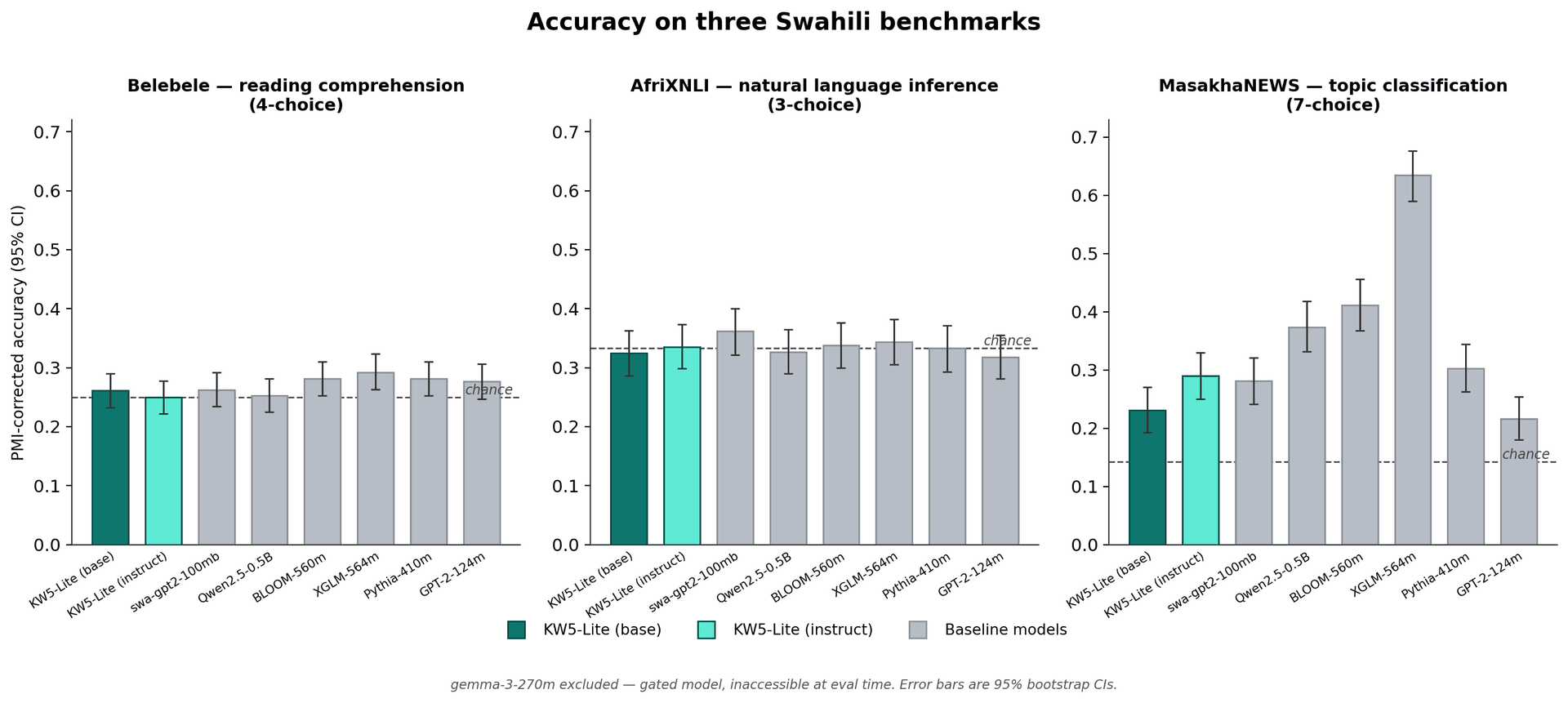
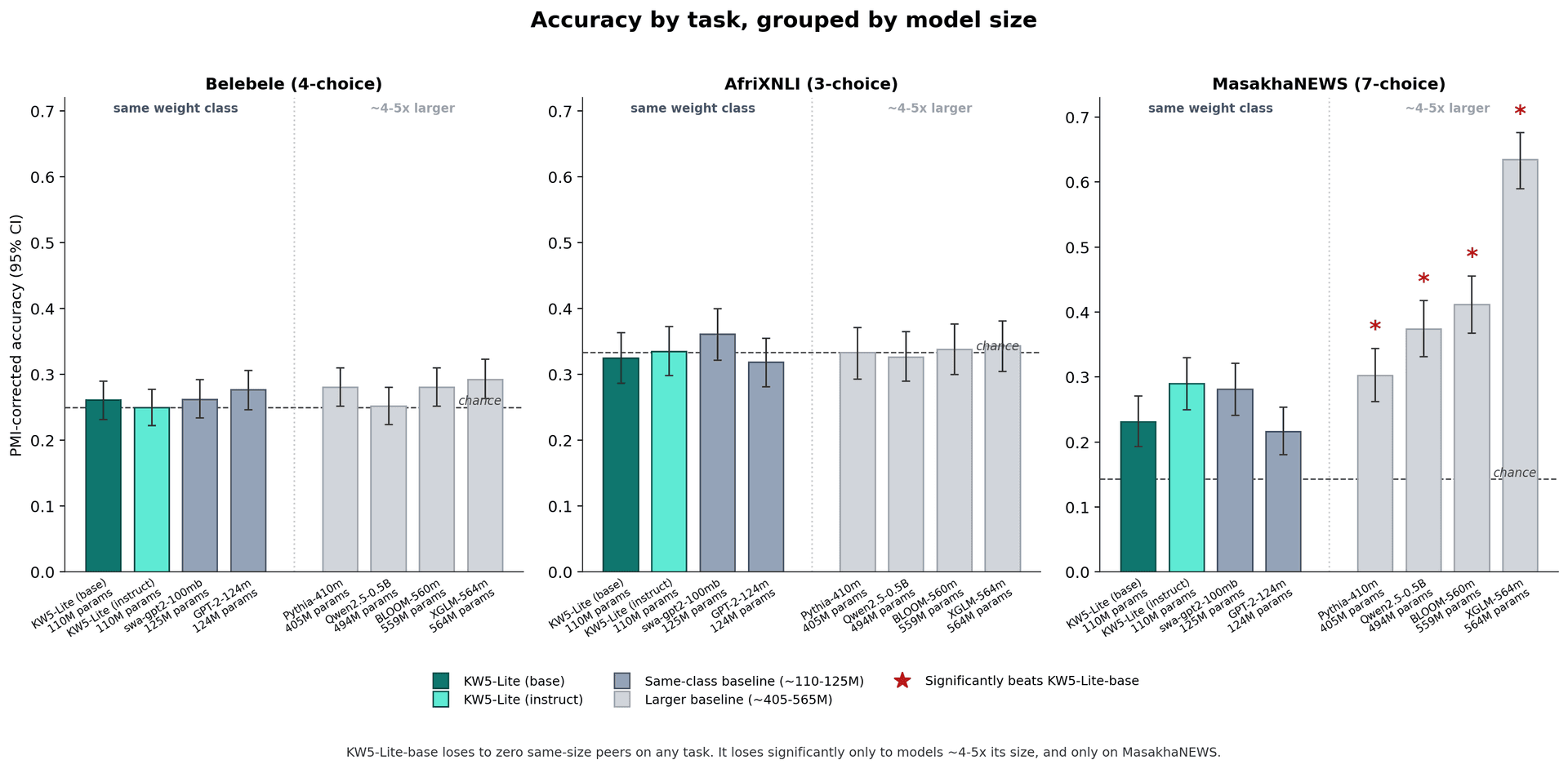
And it does not beat those models on the reasoning tasks. Both halves of that are the result. Nine models were run on one seeded pass over three Swahili benchmarks; the artifacts are linked at the foot of this section.
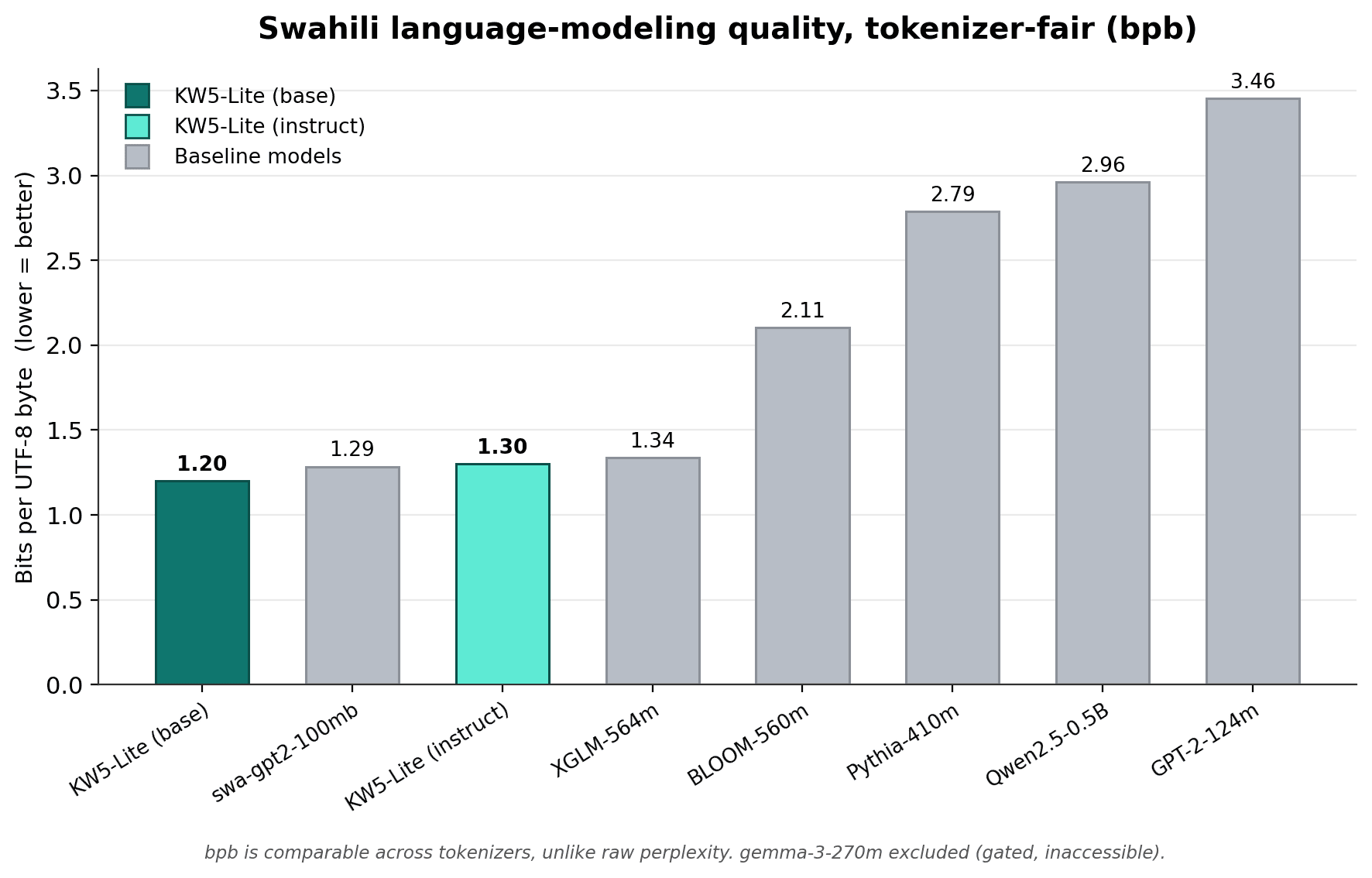
Bits per byte, held-out Swahili
1.201
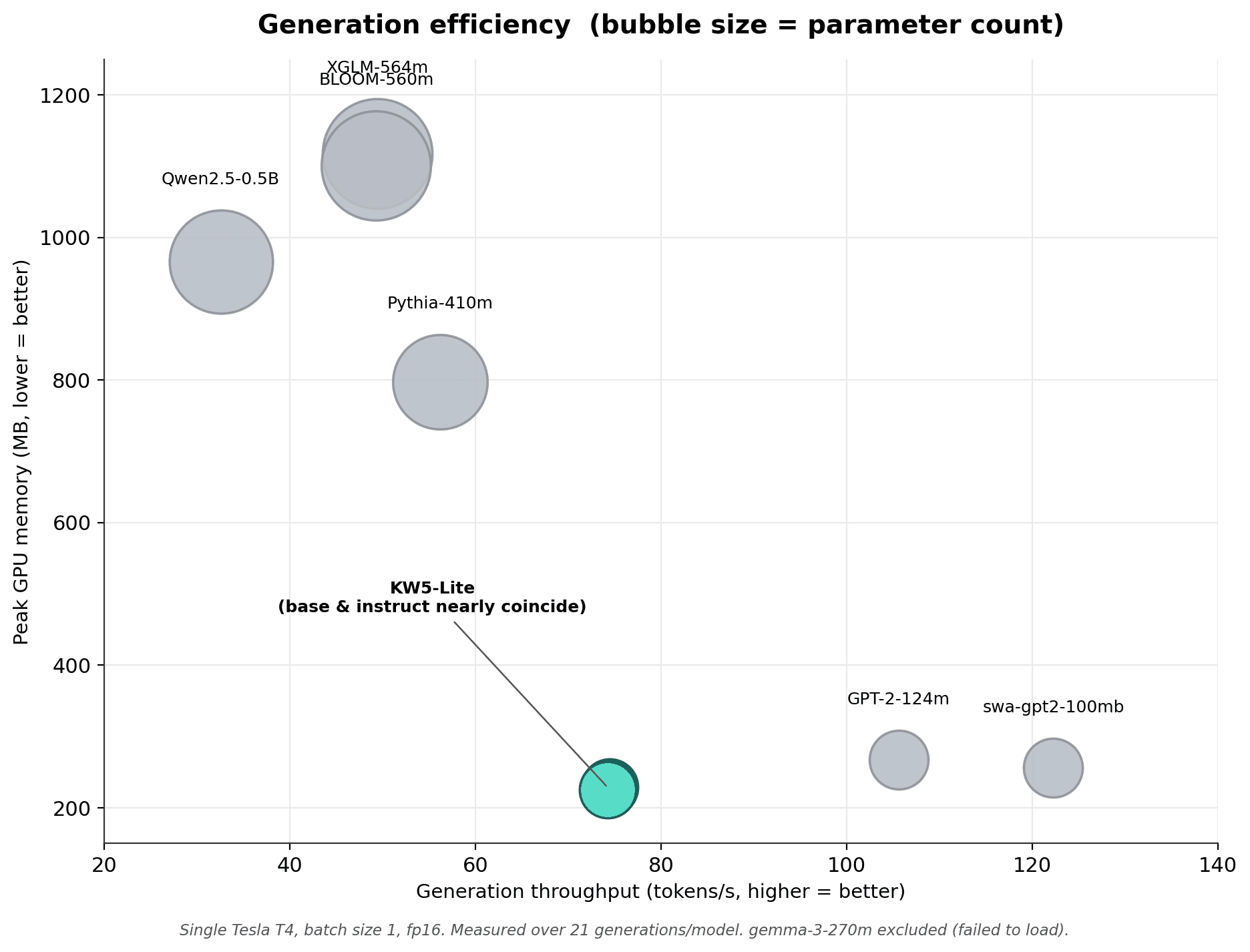
Lowest in the field, from the smallest model in it, at 229MB of peak GPU memory. XGLM-564M needs 1.1GB to reach 1.336.
Leaderboard: PMI-normalized accuracy
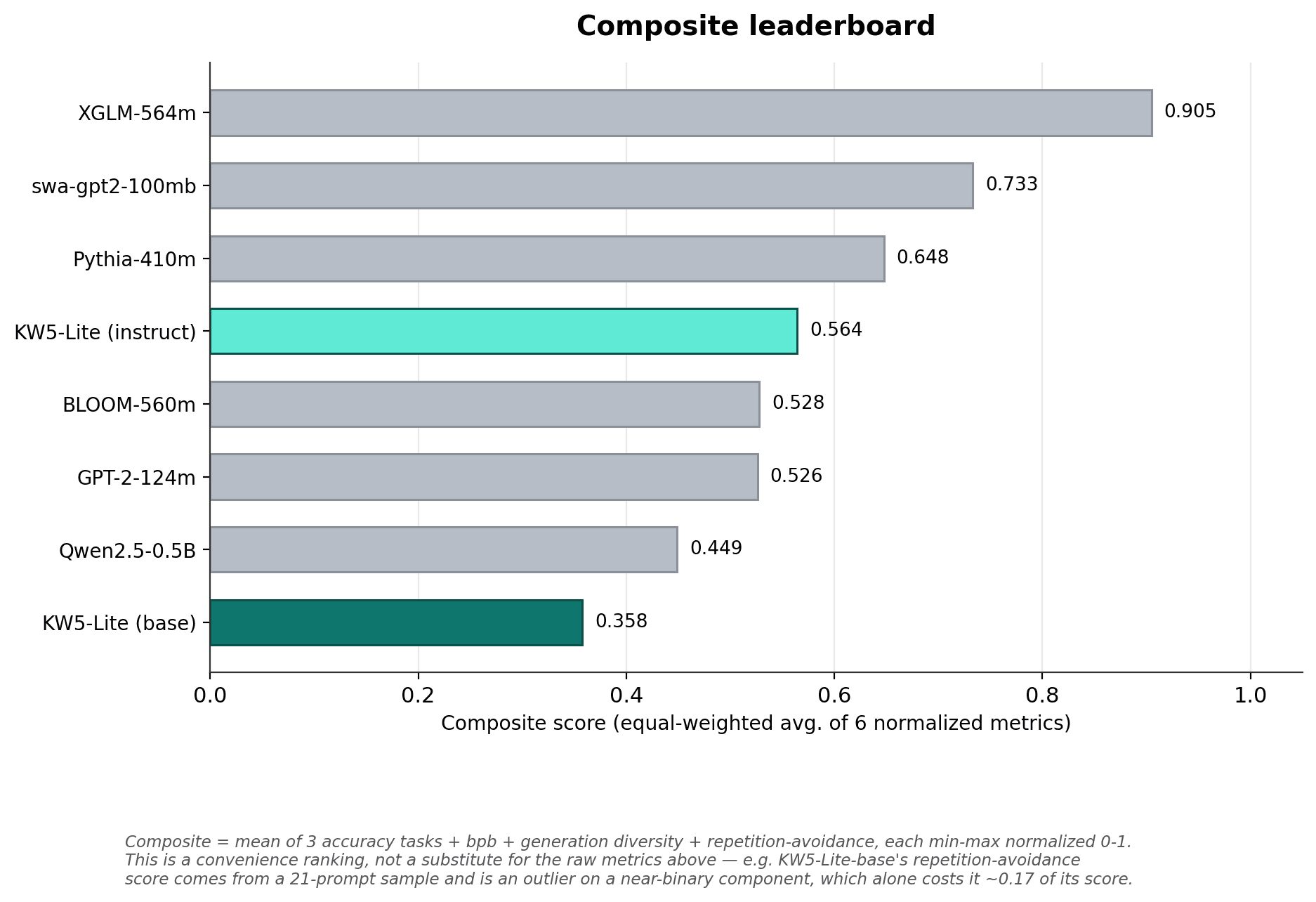
| Model | Params | bpb ↓ | Belebele | AfriXNLI | MasakhaNEWS | tok/s | Peak MB | Composite |
|---|---|---|---|---|---|---|---|---|
| Random chance | 25.0% | 33.3% | 14.3% | |||||
| KW5-Lite (base)RegnantSwahili specialist | 109.5M | 1.201 | 26.1% | 32.5% | 23.1% | 74.5 | 229 | 0.358 |
| KW5-Lite (instruct)RegnantSwahili specialist | 109.5M | 1.302 | 25.0% | 33.5% | 29.0% | 74.3 | 225 | 0.564 |
| swa-gpt2-100mbSwahili specialist | 124.8M | 1.285 | 26.2% | 36.2% | 28.1% | 122.3 | 257 | 0.733 |
| XGLM-564MMultilingual compact | 564.5M | 1.336 | 29.2% | 34.3% | 63.4% | 49.4 | 1118 | 0.905 |
| BLOOM-560mMultilingual compact | 559.2M | 2.105 | 28.1% | 33.8% | 41.2% | 49.3 | 1101 | 0.528 |
| Qwen2.5-0.5BMultilingual compact | 494M | 2.963 | 25.2% | 32.7% | 37.4% | 32.6 | 966 | 0.449 |
| Pythia-410mEnglish-only control | 405.3M | 2.788 | 28.1% | — | 30.3% | 56.2 | 798 | 0.648 |
| GPT-2-124mEnglish-only control | 124.4M | 3.455 | 27.7% | — | 21.6% | 105.6 | 268 | 0.526 |
| Gemma-3-270mNon-complete | — | — | — | — | — | — | — | — |
Reading the table
01
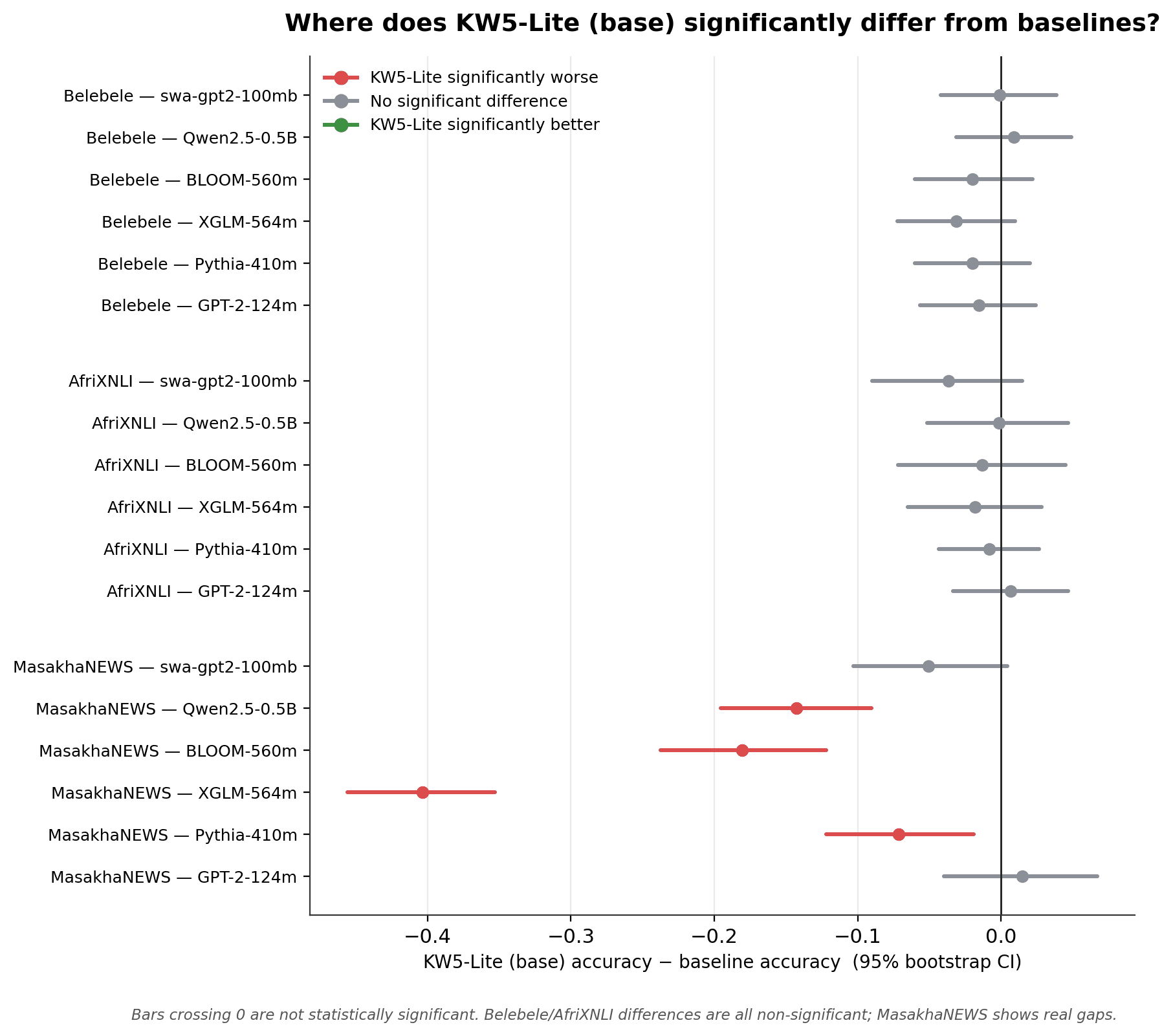
On Belebele every model in the field sits within a few points of the 25% chance line, and on AfriXNLI within a few points of 33%. Paired bootstrap intervals for KW5-Lite against every baseline on both tasks cross zero. No model here can read a Swahili passage and answer a question about it.
02
MasakhaNEWS is where the intervals stop crossing zero. XGLM-564M reaches 63.4% and KW5-Lite base 23.1%, a gap of forty points that the bootstrap confirms. Five times the parameters and a hundred languages of pretraining buy real topic classification.
03
Bits per byte measures how well the weights model Swahili text itself, and it is the one number comparable across tokenizers. KW5-Lite base is first at 1.201, ahead of XGLM at 1.336 and every English-pretrained model by a factor of two, with a fifth of XGLM's memory.
Figures, as the run produced them
Check it yourself
Run 2ff422c0be23, seeded at 20260904, on a single Tesla T4 under torch 2.11.0+cu128. The manifest pins the exact revision hash of every model weight evaluated.
01Where it holds up
Use the instruction-tuned variant for conversational applications: casual question and answer, language practice, general knowledge that is well attested. The base model is for research and further fine-tuning.
02Where it fails
These are on the published cards. A 109.5M parameter model trained on 2.1B tokens has limits, and printing them is cheaper for everyone than letting someone discover them in a production deployment.
01
The base model is trained for language modeling only. It doesn't follow instructions or engage in conversation without fine-tuning. Use the instruction-tuned variant for conversational applications.
02
Trained primarily on standard Tanzanian Kiswahili. Casual phrasing, Sheng-influenced input, and other Swahili dialects make it noticeably less reliable.
03
The 109.5M parameter size limits factual knowledge capacity. It will confidently generate plausible-sounding but factually incorrect information for topics outside its training data, especially current events and specialized domains.
04
2048 token context window (roughly 1000 tokens effective in conversation). Long conversations or documents exceed this limit, causing the model to lose earlier context.
Do not use it for
Medical, legal, or financial advice. Any decision a person or an institution has to stand behind. Any workflow where a confident invented answer would be acted on.
Nothing in the Regnant portfolio depends on this model for consequential work. Where a system needs a decision it can defend, it is built to show its evidence, not to be trusted on fluency.
03What it is a step toward
A translation layer over an English model inherits every place that model has nothing to say. KW5-Lite holds Kiswahili at the weights— trained from scratch on 2.1B Swahili tokens. It is small and limited, but it proves the approach. The point of publishing it is that the next one has something to beat.
Get it
Base model on Hugging Face ↗Instruction-tuned model on Hugging Face ↗Base model: Standard PyTorch format, HuggingFace compatible. Instruct model: LoRA fine-tuned on 22.5K Swahili instruction pairs. Both models use modern architecture with RMSNorm, RoPE, and SwiGLU.
Related
Milkshake, the education ecosystem →The LUGHA programme →